BLACK WIDOW Independent Aerospace Research Program Ukraine Phase I Research Validation TRL 2–3 → 4 (target)
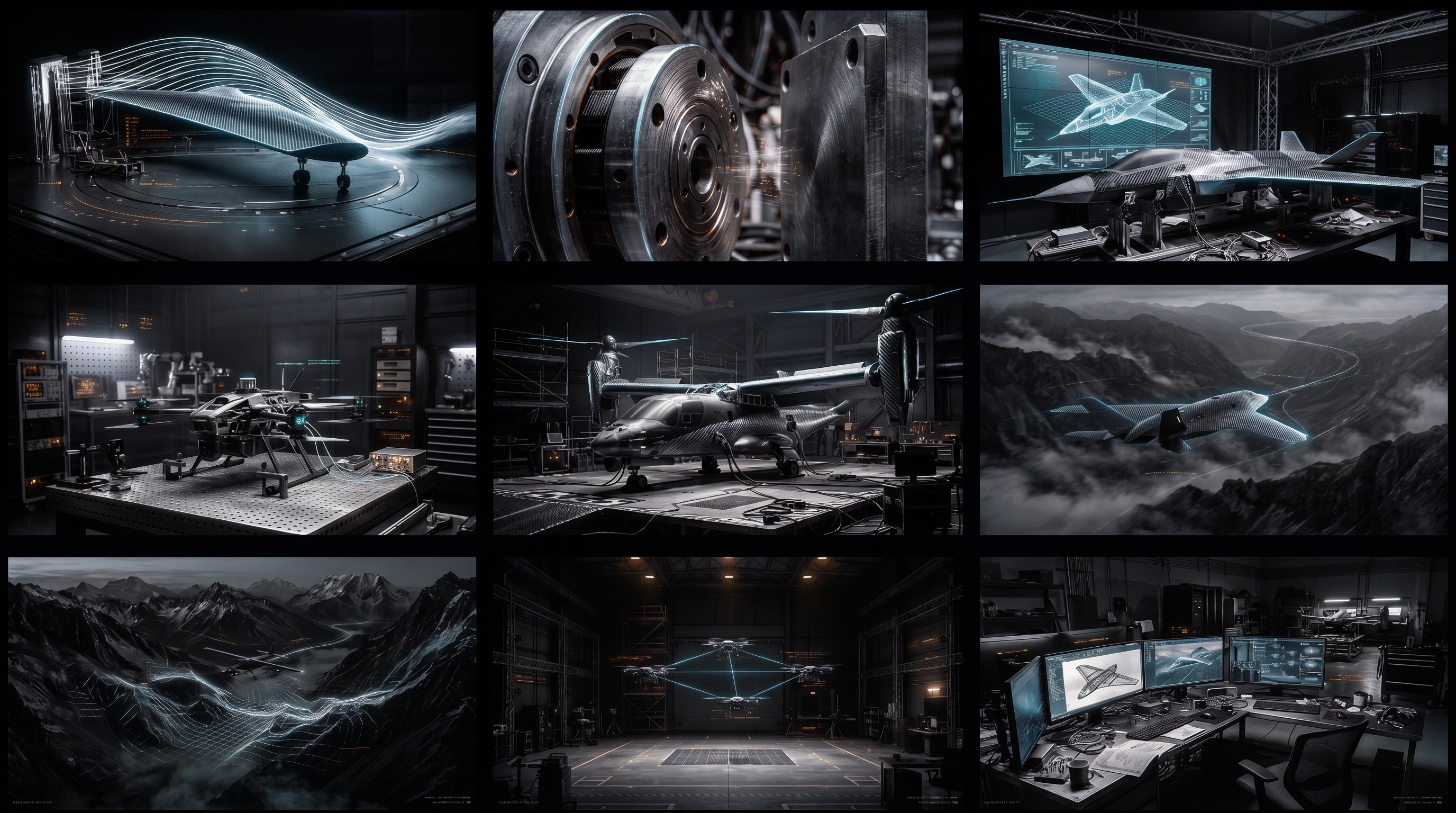
Aerospace research laboratory with the BW-C45 experimental prototype, FlyScout module, ALBATROSS atmospheric sensing pod, and OWL wing test article on a workbench, while engineers review CAD renders and telemetry on dual monitors.
  • Printing complete · 85 parts photo-verified
  • Dry assembly · in progress
  • Next · Ground testing · Phase I funding requested

We are building the BW-C45 research UAV — and seeking Phase I funding for flight testing.

Printing is complete: 85 structural components photo-verified. Phase I will finish the flight prototype, integrate avionics, and run the first ground and flight validation of seven research technologies — Mission OS, FlyScout, EPM, OWL, ALBATROSS, GNSS-denied navigation, and Digital Twin.

Research Platform

BW-C45 · Experimental Research Platform

The program validates seven integrated engineering hypotheses for a small fixed-wing UAV — Mission OS, FlyScout, EPM, OWL, ALBATROSS, GNSS-denied navigation, and Digital Twin.

BW-C45 modular fixed-wing research platform in exploded assembly view — light grey airframe sections, wing test article, and avionics interfaces on a dark engineering panel with subtle CAD overlays.

Purpose

Experimental testing of a portfolio of advanced aerospace technologies under real flight conditions.

Instrument

BW-C45 airframe · a flight-configurable test platform, not a commercial UAV. The aircraft exists to make the technologies measurable.

Outcome

Proven technologies applicable to both defense and civilian aerospace systems. The knowledge is the final product.

Phase I

Phase I Research Directions

Seven Phase I research directions tested through the BW-C45 platform. Each is an independent track with its own hypotheses and success criteria.

Research aircraft in flight with wind-field streamlines, optimal trajectory path, and energy-optimization overlays — portfolio visualization for wind-aware and autonomous flight research programs.
Mission planning workstation: three displays showing abstract flight-path geometry and telemetry curves, industrial keyboard, engineering notebook, prototype electronics board, and compact data-acquisition unit on a clean desk.

Program · 01

Mission OS

Mission planning & execution

Mission OS is a TRL 2–3 web-based platform for autonomous mission planning (Phase I target: TRL 4) — mission preparation, flight-test monitoring, and post-test data analysis. Phase I validates whether the system reduces data-processing time and error frequency compared with a manual workflow when supporting BW-C45 test operations. The expected outcome is a measured efficiency assessment, auditable logs, and engineering recommendations for the next research iteration.

Compact autonomous inspection robot with mecanum wheels, top-mounted LiDAR sensor, and multiple camera modules on the front, on a laboratory table beside interchangeable sensor modules, a prototype electronics board, and 3D-printed housings.

Program · 02

FlyScout

Autonomous reconnaissance & perception

FlyScout is a 300–400 g research platform combining aerial repositioning with close-range ground inspection — inspired by insect mobility. Civil dual-mode robotics only: infrastructure, agriculture, monitoring, educational SAR. Phase I tests dual-mode operation (air — fast repositioning and overview; ground — stable close inspection in confined spaces) via a bench transition protocol and controlled scenarios; Mission OS integration is planned for Q4 2026. Initial concept: no field transition validated yet.

Experimental hold/release interface for a research vehicle on the BW-C45 carrier platform: EPM bench module, instrumented retention node, and laboratory telemetry for hold/release cycles.

Program · 03

EPM

Electromagnetic module retention and release system

Deployment mechanism without continuous current (IEEE reference). Phase I — bench hold/release cycles under vibration profiles matching BW-C45 carrier flight; the operator retains release authority. Lab prototype → n≥50 tests with protocol. Expected outcome: measured separation reliability before field claims.

Aerodynamic wing study inside a modern wind tunnel: matte carbon-fiber airfoil section on a precision mount, with subtle streamlines and colored pressure gradients over the surface. Laser-based measurement equipment visible in the foreground.

Program · 04

OWL

Aerodynamic efficiency & low-signature flight

OWL tests passive aerodynamic wing inserts under controlled comparative trials. Phase I validates whether the inserts produce a measurable change in aerodynamic efficiency and/or acoustic signature relative to the baseline configuration. The expected outcome is a quantitative effect assessment that confirms or refutes the design hypothesis with measured data.

Experimental research aircraft in gentle cruise flight above cumulus cloud layers, with subtle translucent wind-current ribbons visualizing natural atmospheric flow. Soft morning light, clean blue sky.

Program · 05

ALBATROSS

Wind-aware energy optimization & endurance

ALBATROSS validates a wind-aware energy-optimisation algorithm for flight planning. Phase I tests whether the algorithm reduces energy consumption compared with a baseline flight mode under varying wind conditions. The expected outcome is measured energy-efficiency indicators and an engineering assessment of the planning method.

Foreground: BLACK WIDOW research aircraft in a bright research hangar. Background: several civilian aerospace applications — infrastructure inspection, environmental monitoring, agricultural survey, university research and engineering education environments — connected through a shared industrial design language.

Program · 06

GNSS-Denied Navigation

Flight without GPS · VIO/SLAM research

Research program validating visual-inertial navigation for degraded or absent GNSS signal conditions. Phase I establishes modelling, test protocols, and system architecture; Phase II adds a hardware bench and supervised flight tests under operator control. Expected outcome: measured navigation performance data and engineering recommendations for GNSS-denied operations.

Simulation and digital-twin workstation: dual monitors showing XFOIL aerodynamic analysis, JSBSim flight-dynamics output, and SITL telemetry overlay, with the BW-C45 CAD model rendered alongside validation plots.

Program · 07

Digital Twin

Simulation pipeline & pre-flight validation gate

Digital Twin is an XFOIL/JSBSim/SITL simulation pipeline used to cross-check CFD and flight-dynamics predictions against the as-built BW-C45 platform before flight testing begins. Phase I validates the M1 GO/NO-GO gate: if simulated and measured baseline data diverge beyond a documented threshold, downstream flight tests (OWL, ALBATROSS) are held until the discrepancy is resolved. The expected outcome is a validated simulation-to-flight correlation and a documented M1 report.

Evidence

Engineering Evidence

First BW-C45 prototype — canonical print scope complete. All 85 structural and interface components from the frozen V1 package are photo-verified. Dry structural assembly of the plastic airframe is underway; electronics integration and ground testing follow.

79 STL · 85 components · 100% print scope · August 2026

01 · Components

85 Printed Components

July–August 2026

85 3D-printed BW-C45 components (79 canonical STL positions) arranged for dry-assembly staging

85 · 79 STL · 100% canonical scope

02 · Assembly

Dry Structural Assembly

August 2026

Dry assembly layout — BW-C45 airframe components on staging surface
Dry assembly exploded layout — structural fit check before integration

Dry assembly in progress · plastic structure only

03 · Manufacturing

Manufacturing

July–August 2026

K1 Max — batch of structural airframe parts on build plate after print
FDM print in progress — structural wall section on build plate
K2 Pro — active print job inside enclosed build chamber

Creality K1 Max ×2 · print scope complete

04 · Drawings

Engineering Drawings

2026 Q1

Isometric CAD render — Fuselage Section 1 · BW-C45-DWG-002
Isometric CAD render — Left Wing Section 1 · BW-C45-DWG-003

Canonical STL · isometric baseline

Why Phase I

Why Phase I Funding

Digital design and component manufacturing were completed with internal team resources. Dry structural assembly is underway. A flight-ready prototype and the first experimental validation cycle require Phase I funding the team cannot self-finance at this stage.

  1. Complete

    Manufacturing · Print scope 100%

    85 components · photo-verified
  2. Now

    Dry structural assembly

    Plastic airframe · in progress
  3. Phase I target

    Flight-Ready Platform

    Funded by Phase I
  4. Phase I outcome

    First Test Cycle

    Reports · data · recommendations

What Phase I funds

  1. Platform completion — flight-configuration prototype materials and structural integration
  2. Flight instrumentation — avionics, propulsion, and measurement systems integration
  3. Validation methodology — ground and flight test protocols for seven research threads
  4. Test operations — controlled ground checks and first flight test campaigns
  5. Reports & data release — engineering reports, measured datasets, and validation summaries
Phase I budget $84,000 (Phase I) · $96,667 turnkey · Turnkey Budget · 45 UAH/USD

Research Program

Phase I Research Program

Seven research threads · Falsifiable hypotheses · Measured outcomes.

RC-01

Flight Testing

Research Question

Does the flight behaviour of the BW-C45 airframe match calculated performance parameters?

Expected Result

Measured flight characteristics with calculated data confirmed or corrected.

RC-02

Mission OS Evaluation

Research Question

Does Mission OS reduce data-processing time and error frequency compared with a manual workflow during flight-test operations?

Expected Result

Efficiency assessment, auditable logs, and recommendations for system refinement.

RC-03

EPM

Research Question

Does the EPM mechanism provide reliable retention and controlled subdrone separation under load?

Expected Result

Measured hold and release reliability data plus structural design recommendations.

RC-04

OWL Aerodynamic Study

Research Question

Do the wing inserts produce a measurable improvement in aerodynamic efficiency and/or noise reduction?

Expected Result

Quantitative effect assessment confirming or refuting the design hypothesis.

RC-05

ALBATROSS Endurance Study

Research Question

Does the algorithm reduce energy consumption compared with baseline flight mode under varying wind conditions?

Expected Result

Measured energy-efficiency indicators and an engineering assessment of the planning method.

RC-06

GNSS-Denied Navigation

Research Question

Can VIO/SLAM provide stable navigation performance under degraded or absent GNSS signal conditions?

Expected Result

Phase I — validated protocols and system architecture; Phase II — measured navigation performance from hardware bench and supervised flight tests, plus engineering recommendations for GNSS-denied operations.

RC-07

Digital Twin Validation Gate

Research Question

Does the simulated (XFOIL/JSBSim/SITL) baseline correlate with as-built platform data within an acceptable margin before flight testing proceeds?

Expected Result

Documented M1 GO/NO-GO report confirming or flagging divergence between simulated and measured baseline data, gating downstream flight campaigns.

Deliverables

Expected Deliverables

Engineering Reports

Documentation from flight-prototype integration: structural configuration, subsystem interfaces, and as-built engineering baseline for the BW-C45 test platform.

Test Reports

Validation reports for all seven research threads: Flight Test, EPM, OWL, ALBATROSS, Mission OS, GNSS-denied navigation, and Digital Twin — each with measured results and test methodology.

Recommendations

Engineering recommendations for the next BW-C45 iteration and Mission OS refinement, based on confirmed or refuted hypotheses from Phase I testing.

Measured Data

Flight logs, power telemetry, sensor recordings, and processed datasets from ground and flight test campaigns — released as structured research artefacts.

Documents

Documents

Public research documents are available for download. Internal engineering artefacts are never published.

Level 1 · Public

PDF · EN · 3 pages · vRC3 · 2026-07-29

Executive Brief RC3

Program overview for grant committees, partners, and investors. Phase I $84,000 · turnkey $96,667 (45 UAH/USD). Modules, staged funding, research positioning.

Download PDF

Level 1 · Public

PDF · EN · 5 pages · vRC3 · 2026-07-29

Turnkey Budget RC3

Grant-ready turnkey budget in USD: Phase I $84,000 · turnkey $96,667 (45 UAH/USD). Work packages, deduplication, 10% reserve, Phase II GNSS/VIO, staged funding.

Download PDF

Level 1 · Public

PDF · EN · 2 pages · v1.0 · 2026-07-28

Research Summary

Summary of completed research milestones and platform state. Phase I $84,000 · turnkey $96,667 (45 UAH/USD). Seven Phase I research threads including GNSS-denied navigation and Digital Twin.

Download PDF

Program Contact

Program Contact

General institutional contact for the BLACK WIDOW research program. Personnel data and facility information are shared only with authorized reviewers through secure channels.